Curriculum
1st year
Semester 7
- TU General Introduction to Intellectual Property (33 hours - 4 credits)
- TU Private International Law (33 hours - 4 credits)
- TU Advanced Competition Law (33 hours - 4 credits)
- TU Distribution Law (Sales/Services) (33 hours - 4 credit hours) + Tutorials
- TU General Tax Law (33 hours—4 credits) + Tutorials
- TU Civil Law: Security Interests (33 hours - 4 credits)
- TU Language (8th Grade)
Semester 8
- TU Intellectual Property Law (33 hours - 4 credits)
- TU Private Law of Digital Technology (33 hours - 4 credits)
- TU Public Law of Digital Technology (33 hours - 4 credits)
- TU Distribution Law (Networks/Groups) (33 hours, 4 credits) + Tutorials
- TU TU 's Business Law (33 hours—4 credits) + Tutorials
- TU Commercial Law: Insolvency Proceedings (33 hours - 4 credits)
- TU Professional Placement (Internship or Research Report) (4C)
- Legal Clinic (optional)
2nd year
Semester 9
- TU Intellectual Property Practice (104h-8C)
- TU Intellectual Property Contracts (45h-7C)
- TU European and International Intellectual Property Law (20 hours - 6 credits)
- TU Substantive and Procedural Law of Intellectual Property Infringement (30 hours–6 credits)
- TU C2i “Legal Professions” (PIX) (12 hours–3 credits)
Skills acquired:counseling (legal clinic) + case analysis + literature review + oral presentation with PowerPoint slides (presentation) + contract drafting
Semester 10
- TU Innovation Management and Strategies (36 hours, 6 credits)
- TU Online Communication Law (Stakeholders, Tools, and Liability) (44 hours - 7 credits)
- TU E-Commerce Law (Parties, Instruments, and Contracts) (27 hours - 7 credits)
- TU Language – IP/IT Law (20 hours–3 credits)
- TU Supervised Project (Research Thesis or Learning Thesis) (4C)
Skills acquired:moot court competition (National Intellectual Property Moot Court Competition – CN2PI) + organization of a symposium titled “Current Developments in Digital Law” + drafting of case law summaries
Annual Calendar
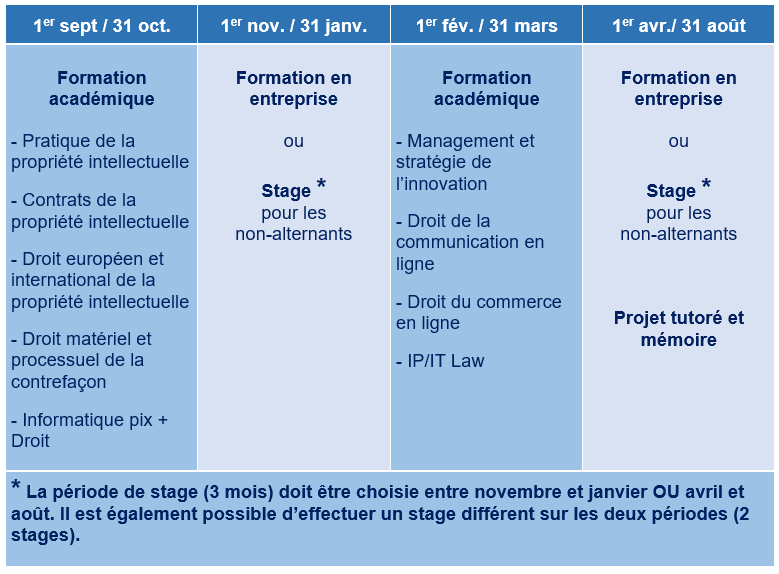
Work-Study Programs and Apprenticeships
Annual Schedule for the Work-Study Program in the Second Year of the Master’s Program
The schedule is the same for all training participants; see the Annual Schedule.
Number of training hours
Academic training: 344 hours
On-the-job training: 980 hours
Supervised project: 140 hours
A few rules regarding work-study programs:
- The apprenticeship contract is drawn up in writing and then signed by the employer, the apprentice, or the apprentice’s legal representative, using form Cerfa No. 10103*07 or FA 13. In addition to general information about the employer and the apprentice, the contract specifies that the apprenticeship supervisor meets the required professional competency standards.
- The apprenticeship contract is open to young people between the ages of 16 and 29 at the start of the apprenticeship (Article L6222-1 of the Labor Code); in other words, the contract must begin no later than the day before the apprentice’s 30th birthday.
- The duration of the apprenticeship contract is equal to that of the “training program leading to the qualification covered by the contract.” In all cases, the minimum duration of training at a training center must be equal to 25 percent of the contract’s duration—for example, at least 402 hours for a 12-month contract.
- The start date of the on-the-job training with the employer may not be more than three months after the contract start date. The start date of the training period at the apprentice training center.
- The apprenticeship supervisor is responsible for supporting the apprentice and helping the apprentice acquire the skills required for the desired qualification, in collaboration with the CFA. This role may be shared among several employees. The apprenticeship supervisor must be an employee of the company, have volunteered for the role, be of legal age, and be of good moral character.
- Apprenticeships are not available to new arrivals; international students may not enter into an apprenticeship contract until after their first year in the country. Foreign applicants who hold a residence permit may, once they have signed an apprenticeship contract, apply for a work permit from the Foreign Labor Office (MOE), which is part of the DIRECCTE.
- An apprentice with a disability may be officially recognized in order to fully exercise his or her rights. To do so, the application for Recognition of Status as a Worker with a Disability (RQTH) must be submitted to the Departmental Office for People with Disabilities (MDPH) in the applicant’s place of residence.
- The terms and conditions of apprenticeships in the public sector are the same as those in the private sector, with a few exceptions. Apprenticeship contracts signed with a public agency are fixed-term contracts governed by private law (CDD).
- If the apprentice fails the exam, the apprenticeship contract may be extended—either with the same employer through an amendment to the contract or by entering into a new contract with another employer. However, this extension may not exceed one year. In the event of another failure, no further extension may be granted.
Please note, however, that you cannot repeat the second year of the Master's program!
Since January 1, 2019, apprentices have been eligible for a €500 grant to help cover the cost of obtaining a driver’s license. This state-funded grant is processed and disbursed by the CFA.
For more information on work-study contracts, see CFA-EnsupLR